John F. Kennedy, 1963:
Two thousand years ago the proudest boast was civis Romanus sum [I am a Roman citizen]. Today, in the world of freedom, the proudest boast is Ich bin ein Berliner... All free men, wherever they may live, are citizens of Berlin, and, therefore, as a free man, I take pride in the words Ich bin ein Berliner!
Ronald Reagan, 1987:
We welcome change and openness; for we believe that freedom and security go together, that the advance of human liberty can only strengthen the cause of world peace. There is one sign the Soviets can make that would be unmistakable, that would advance dramatically the cause of freedom and peace. General Secretary Gorbachev, if you seek peace, if you seek prosperity for the Soviet Union and eastern Europe, if you seek liberalization, come here to this gate. Mr. Gorbachev, open this gate. Mr. Gorbachev, tear down this wall!
George H.W. Bush, 1989:
Just as the barriers are coming down in Hungary, so must they fall throughout all of Eastern Europe. Let Berlin be next—let Berlin be next!
Bill Clinton 1999:
We are here today to celebrate the ideal we cherish above all others - human freedom - and to celebrate the day that ideal triumphed in one city in the heart of Europe. We must remember the role America played in the victory of freedom in Europe, and all we've done since to help realize its promise. Most important, we must reaffirm our determination to finish the job.
George H.W. Bush, 2009:
The point needs to be made that the historic events we are gathered to celebrate were set in motion not in Bonn, or Moscow or Washington but rather in the hearts and minds of the people who had too long been deprived of their God-given rights.
The Wall could never erase your dream, our dream of one Germany, a free Germany, a proud Germany.
Barack Obama, 2009:
Doody doody doo.
***Edited to add:
In a surpise video appearance yesterday, Obama did address the anniversary of the fall of the Berlin wall:
Few would have foreseen ... that a united Germany would be led by a woman from Brandenburg or that their American ally would be led by a man of African descent.
(Because it's about him, isn't it?)
Showing posts with label history. Show all posts
Showing posts with label history. Show all posts
Monday, November 09, 2009


Wednesday, November 26, 2008
I hope you all are ready for Thanksgiving. R is flying home tomorrow to visit with his folks, and F isn't coming home until next week, so I will have dinner with my friend Kristina and her family.
Kristina told me that her sister instructed her to get at least a 24-pound turkey this year.
"Does your family kick in to help pay for this?" I asked.
"No, they don't have any money," K said.
"People left the table hungry last year?" I asked.
"No," Kristina said, "but they'll all want to take leftovers home."
That's family for you!
But I admit to having grilled Kristina about the kind of gravy she will have to put on the dressing. K doesn't have any strong feelings about gravy one way or the other. I then quizzed the internet, and my mom, about how one goes about making giblet gravy. And I put together some chicken broth I had in my freezer, some onion and celery, and a bit of flour I stirred into some of the broth and then returned to the mix, and separately, a couple of boiled eggs to be chopped and added, and delivered this to her today so that all she has to do is chop the turkey innards and put them in and simmer. And I'll be bringing chocolate chip pies as well.
Jeff at Quidplura offers this recipe that appears to have stood the test of time:
A goos in hogepotte. —Take a Goos, & make hure clene, & hacke hyre to gobettys, & put yn a potte, & Water to, & sethe to-gederys; þan take Pepir & Brennyd brede, or Blode y-boyled, & grynd y-fere Gyngere & Galyngale & Comyn, & temper vppe with Ale, & putte it þer-to; & mynce Oynonys, & frye hem in freysshe grece, & do þer-to a porcyon of Wyne.
He made a run at this dish, and offers his observations on the results, with pictures.
Kristina told me that her sister instructed her to get at least a 24-pound turkey this year.
"Does your family kick in to help pay for this?" I asked.
"No, they don't have any money," K said.
"People left the table hungry last year?" I asked.
"No," Kristina said, "but they'll all want to take leftovers home."
That's family for you!
But I admit to having grilled Kristina about the kind of gravy she will have to put on the dressing. K doesn't have any strong feelings about gravy one way or the other. I then quizzed the internet, and my mom, about how one goes about making giblet gravy. And I put together some chicken broth I had in my freezer, some onion and celery, and a bit of flour I stirred into some of the broth and then returned to the mix, and separately, a couple of boiled eggs to be chopped and added, and delivered this to her today so that all she has to do is chop the turkey innards and put them in and simmer. And I'll be bringing chocolate chip pies as well.
Jeff at Quidplura offers this recipe that appears to have stood the test of time:
A goos in hogepotte. —Take a Goos, & make hure clene, & hacke hyre to gobettys, & put yn a potte, & Water to, & sethe to-gederys; þan take Pepir & Brennyd brede, or Blode y-boyled, & grynd y-fere Gyngere & Galyngale & Comyn, & temper vppe with Ale, & putte it þer-to; & mynce Oynonys, & frye hem in freysshe grece, & do þer-to a porcyon of Wyne.
He made a run at this dish, and offers his observations on the results, with pictures.
Sunday, October 26, 2008
Chicagoboyz has a post up: Blinded By His Narrow Focus. It's about an article the blog author read, that seems to extrapolate conditions in a county in California to the rest of the country.
I started to comment on it and then realized that my comments were running too long, so I decided to park them here.
I lived in Memphis, TN from 1982 until last year. When my daughter was in first grade - that would have been in 1993 or so - there weren't very many Hispanics in Memphis. Her class studied Mexico during multicultural week. One of my coworkers, a Mexican-American, was kind enough to speak to her class and answer questions about Mexico because no one in the school had any direct experience. By the time she finished elementary school, there were a few Hispanic children in some of the classes. Not long after, a third to a half of the school was Hispanic. (This was a parochial school.) Memphis experienced a big demographic shift, during which we saw some things we were not used to seeing, including Hispanic-looking people standing around outside Home Depot. (I never inquired as to their immigration status.) Billboards, flyers, newspapers in Spanish appeared and then increased in number too. No one planned this or decided it should happen, it just happened
My point(s)?
1 - Nothing, NOTHING is static. It never was. Memphis was never frozen in time. The Hispanic demographic shift was visible because of the Spanish-language stuff, and the schools suddenly had to add a lot of ESL classes, sure. But busing for desegregation happened, white flight happened, etc., long before this. Also waves of immigrants from countries where they were fleeing oppression, so that certain parts of town began to see Vietnamese restaurants and grocery stores, and various things of that nature. You can't really pick a moment in the past and say "this is the real Memphis". The only constant is change, right? Xenophobes and other people who can't handle change are going to have heartburn but they can't stop the process.
2 - Nothing stays put, either. Today Marin County, CA, tomorrow Podunk, OH. I should say "nothing people-related". El Ninos aren't going to suddenly start causing drought in Texas and flooding in California. But there's not a wall up between California and Ohio so even though the article might not speak to conditions today, the blog post author might re-read it two or three years from now in a different light.
But I keep thinking about cells. Cells have membranes, not walls, so that things can move in and out of the cells as needed for the cells to survive. [Edited to add: some non-animal cells have walls, of course.] The movement in and out is strictly controlled. If a cell membrane is destroyed, the cell no longer has integrity and it can't function any longer. I think eventually the world will be like one big cell. This process started happening with pre-Roman Empire trade routes and really started accelerating with steam ships and railroads and trans-continental air travel, and the internet by which we can read newspapers in other countries and have conversation with their inhabitants; and NAFTA and free trade and all that other stuff. But we're not there yet, and I wonder what kind of cell membrane the USA really needs. Maybe I'm a xenophobe but I wonder if we've let our membrane weaken prematurely.*
When I think about all the illegal immigrants who come here to find work, and why it is that they can find it (because employers can sidestep OSHA regs and labor laws if they know their employees won't complain) I wonder about capitalism. I wonder if it's true, as Marx(?) said, that capitalism requires an underclass. First the US had slaves, then black people without civil rights, then when black people got the same rights that white people had, suddenly we needed a new class of people without rights. Is that it? Or is it not necessary except for those capitalists who want too much profit and are willing to break the law to get it? I bet Fred Smith and people of his ilk aren't hiring illegals, and they're not hurting. I've had to show proof of eligibility to work at every job that I remember filling out paperwork for.
Still, it seems that we must somehow want these people here, and in the status they have. If we truly didn't want them, we'd send them out and close our borders, right? Instead of discussing whether, for instance, they should get driver licenses and pay in-state tuition. But since they are here, why is it so hard for those who are self-supporting and law-abiding (as far as they can be) to be regularized? Is it just the usual lumbering monster of bureaucracy, or an inherent flaw in our political system? I wish I knew.
*To continue the membrane analogy - one could look at immigration or at occupation, as a kind of endosymbiosis. The idea of endosymbiosis is that some of the organelles in eukaryotic cells - mitochondria, chloroplasts in plant cells - started out as prokaryotes that moved into other cells either as parasites or as food, and because the larger cell offered some protection and the smaller cell offered energy, it stayed around and reproduced with the larger cell. There's some evidence to support this (mitochondria have their own ribosomes, which are like bacterial ribosomes, and they have their own DNA, which is configured like bacterial DNA, not the X and Y of eukaryotes' nuclear DNA). These things have evolved so that you can't independently culture the mitochondria or the chloroplasts; they can only function as part of the eukaryotic cell. The point is that it doesn't matter now whether the prokaryotes that gave rise to these organelles started out as food or as parasites; they are a vital part of the eukaryotes either way. In the same way, it hopefully doesn't matter whether an American's ancestors came here for a better life, or fleeing famine or oppression, or were brought here in chains - they should be able to both contribute to the "cell" and enjoy the "cell's" benefits, and see themselves and be seen as part of the larger whole. This is hopefully true of our Hispanic immigrants as well. They change us, we change them, and we all benefit.
Adapt or die, right?
I started to comment on it and then realized that my comments were running too long, so I decided to park them here.
I lived in Memphis, TN from 1982 until last year. When my daughter was in first grade - that would have been in 1993 or so - there weren't very many Hispanics in Memphis. Her class studied Mexico during multicultural week. One of my coworkers, a Mexican-American, was kind enough to speak to her class and answer questions about Mexico because no one in the school had any direct experience. By the time she finished elementary school, there were a few Hispanic children in some of the classes. Not long after, a third to a half of the school was Hispanic. (This was a parochial school.) Memphis experienced a big demographic shift, during which we saw some things we were not used to seeing, including Hispanic-looking people standing around outside Home Depot. (I never inquired as to their immigration status.) Billboards, flyers, newspapers in Spanish appeared and then increased in number too. No one planned this or decided it should happen, it just happened
My point(s)?
1 - Nothing, NOTHING is static. It never was. Memphis was never frozen in time. The Hispanic demographic shift was visible because of the Spanish-language stuff, and the schools suddenly had to add a lot of ESL classes, sure. But busing for desegregation happened, white flight happened, etc., long before this. Also waves of immigrants from countries where they were fleeing oppression, so that certain parts of town began to see Vietnamese restaurants and grocery stores, and various things of that nature. You can't really pick a moment in the past and say "this is the real Memphis". The only constant is change, right? Xenophobes and other people who can't handle change are going to have heartburn but they can't stop the process.
2 - Nothing stays put, either. Today Marin County, CA, tomorrow Podunk, OH. I should say "nothing people-related". El Ninos aren't going to suddenly start causing drought in Texas and flooding in California. But there's not a wall up between California and Ohio so even though the article might not speak to conditions today, the blog post author might re-read it two or three years from now in a different light.
But I keep thinking about cells. Cells have membranes, not walls, so that things can move in and out of the cells as needed for the cells to survive. [Edited to add: some non-animal cells have walls, of course.] The movement in and out is strictly controlled. If a cell membrane is destroyed, the cell no longer has integrity and it can't function any longer. I think eventually the world will be like one big cell. This process started happening with pre-Roman Empire trade routes and really started accelerating with steam ships and railroads and trans-continental air travel, and the internet by which we can read newspapers in other countries and have conversation with their inhabitants; and NAFTA and free trade and all that other stuff. But we're not there yet, and I wonder what kind of cell membrane the USA really needs. Maybe I'm a xenophobe but I wonder if we've let our membrane weaken prematurely.*
When I think about all the illegal immigrants who come here to find work, and why it is that they can find it (because employers can sidestep OSHA regs and labor laws if they know their employees won't complain) I wonder about capitalism. I wonder if it's true, as Marx(?) said, that capitalism requires an underclass. First the US had slaves, then black people without civil rights, then when black people got the same rights that white people had, suddenly we needed a new class of people without rights. Is that it? Or is it not necessary except for those capitalists who want too much profit and are willing to break the law to get it? I bet Fred Smith and people of his ilk aren't hiring illegals, and they're not hurting. I've had to show proof of eligibility to work at every job that I remember filling out paperwork for.
Still, it seems that we must somehow want these people here, and in the status they have. If we truly didn't want them, we'd send them out and close our borders, right? Instead of discussing whether, for instance, they should get driver licenses and pay in-state tuition. But since they are here, why is it so hard for those who are self-supporting and law-abiding (as far as they can be) to be regularized? Is it just the usual lumbering monster of bureaucracy, or an inherent flaw in our political system? I wish I knew.
*To continue the membrane analogy - one could look at immigration or at occupation, as a kind of endosymbiosis. The idea of endosymbiosis is that some of the organelles in eukaryotic cells - mitochondria, chloroplasts in plant cells - started out as prokaryotes that moved into other cells either as parasites or as food, and because the larger cell offered some protection and the smaller cell offered energy, it stayed around and reproduced with the larger cell. There's some evidence to support this (mitochondria have their own ribosomes, which are like bacterial ribosomes, and they have their own DNA, which is configured like bacterial DNA, not the X and Y of eukaryotes' nuclear DNA). These things have evolved so that you can't independently culture the mitochondria or the chloroplasts; they can only function as part of the eukaryotic cell. The point is that it doesn't matter now whether the prokaryotes that gave rise to these organelles started out as food or as parasites; they are a vital part of the eukaryotes either way. In the same way, it hopefully doesn't matter whether an American's ancestors came here for a better life, or fleeing famine or oppression, or were brought here in chains - they should be able to both contribute to the "cell" and enjoy the "cell's" benefits, and see themselves and be seen as part of the larger whole. This is hopefully true of our Hispanic immigrants as well. They change us, we change them, and we all benefit.
Adapt or die, right?
Saturday, April 19, 2008
So I'm rereading Edith Wharton's fluffy little novel The Glimpses of the Moon and I ran across this:
He sent a pneumatic telegram to Mrs. Nicholas Lansing to say that he would call on her that afternoon at four.
This is Paris, 1922 or so. What in the heck, I asked the longsuffering R who was trying to read his own book, could a pneumatic telegram be? Is it referring to the inflated tires of the bicycle messengers? For once R couldn't answer my question so I looked it up.
Check this out: The Internet of Tubes
How extremely cool.
He sent a pneumatic telegram to Mrs. Nicholas Lansing to say that he would call on her that afternoon at four.
This is Paris, 1922 or so. What in the heck, I asked the longsuffering R who was trying to read his own book, could a pneumatic telegram be? Is it referring to the inflated tires of the bicycle messengers? For once R couldn't answer my question so I looked it up.
Check this out: The Internet of Tubes
How extremely cool.
Monday, March 31, 2008
Here is an article inviting Memphians to remember where they were and what happened 40 years ago when MLK was assassinated. There are more than 90 comments. It's fascinating to read how people's observations agree and disagree.
I have two rules about discussing racial matters. One is that no one is allowed to read someone else's mind, i.e., assume wrong attitudes and opinions in people he or she doesn't like. The other is that no one is allowed to tell anyone that he didn't see what he saw, hear what he heard, experience what he experienced, etc. Usually the second rule applies to white people who try to tell black people that they are imagining the effects of racism and discrimination - NOT that they are imagining other people's attitudes, because they very well may be, but actual experiences that they have had. But both of those rules cut both ways, really. So in this comment thread you see people saying "I saw X" and other people saying "I doubt X really happened". Did X happen or not? I wonder if it's possible to know, now.
The stories of police brutality are upsetting. I offer this story from Saturday about a black woman and a white policeman as a very uplifting antidote. Some people say nothing has changed in 40 years. Not true.
I have two rules about discussing racial matters. One is that no one is allowed to read someone else's mind, i.e., assume wrong attitudes and opinions in people he or she doesn't like. The other is that no one is allowed to tell anyone that he didn't see what he saw, hear what he heard, experience what he experienced, etc. Usually the second rule applies to white people who try to tell black people that they are imagining the effects of racism and discrimination - NOT that they are imagining other people's attitudes, because they very well may be, but actual experiences that they have had. But both of those rules cut both ways, really. So in this comment thread you see people saying "I saw X" and other people saying "I doubt X really happened". Did X happen or not? I wonder if it's possible to know, now.
The stories of police brutality are upsetting. I offer this story from Saturday about a black woman and a white policeman as a very uplifting antidote. Some people say nothing has changed in 40 years. Not true.
Sunday, June 10, 2007
Interesting article about tuberculosis:
Return of the White Plague
For those of you who consider tuberculosis a thing of the distant past, let me tell you a story. As a young man in 1913, Eugene O'Neill, the future playwright and winner of the Nobel and Pulitzer prizes, was confined for five months to a TB sanatorium. His family considered the initial diagnosis practically a death sentence. They had a point: Tuberculosis was then the leading cause of death for Americans ages 20 to 45. But by living under an enforced regimen of rest, fresh air and exercise, and by eating a diet rich in fat and protein, O'Neill recovered. A young woman he met and fell in love with in the sanatorium was not nearly so fortunate. Emaciated, pale and weak, she entered her last bloody round of violent coughing 18 months later. Writing about her death, O'Neill described tuberculosis as a cruel game of drawing straws, with more short straws than long ones.
I read a book, and then lent it out and didn't get it back, about the tuberculosis pandemic of the 19th century. Besides killing real-life people - the article lists a few - the disease figures in literature of the day. Anna Karenina and Portrait of a Lady come to mind. It appears that just about everyone had some degree of infection at that time. If you were lucky, your immune system stayed on top of it. The sanatoria were for people who got run down and the disease got the upper hand - they were made to rest and eat so they could knock their infections back down. It was something to be managed, like diabetes is today. Really bad cases might be treated with surgery, but remember that they didn't have the imaging we have now - no x-ray, no MRI, no CT. They could only listen with a stethoscope and try to figure out where the infection probably was. It's amazing that the human race survived.
People tend to get blase about diseases because they are treatable. Jim Henson, the Muppet guy, died of pneumonia because he wouldn't go to the doctor until he was too sick to be saved. It's rare for an otherwise healthy person to die of pneumonia these days - used to be fairly frequent before antibiotics came along. But if you don't go to the doctor when you're sick, it might as well be 1850 instead of 2007.
And don't get me started on people who think that vaccinations are worse than the diseases they prevent - yes, there are people who say that. Shocking ignorance of even recent history. My brother-in-law's girlfriend asked me once if I thought AIDS was a government experiment gone bad. I told her no, I thought we were spoiled. I turned to my MIL and invited her to tell this woman about the polio epidemic that swept through when my FIL was off in the military and she was home with two little boys and no way to go anywhere except on the city bus - and you were supposed to avoid crowds. Every time one of them sneezed she was terrified. The pediatrician would stop by her apartment on his way in to the office to check them out and tell her they did not have polio. My mother's little brother died of diphtheria as a toddler. We get immunized now and don't have to think about these things, but fear of disease used to be a way of life. It's not outside the realm of possibility that it will be again.
Return of the White Plague
For those of you who consider tuberculosis a thing of the distant past, let me tell you a story. As a young man in 1913, Eugene O'Neill, the future playwright and winner of the Nobel and Pulitzer prizes, was confined for five months to a TB sanatorium. His family considered the initial diagnosis practically a death sentence. They had a point: Tuberculosis was then the leading cause of death for Americans ages 20 to 45. But by living under an enforced regimen of rest, fresh air and exercise, and by eating a diet rich in fat and protein, O'Neill recovered. A young woman he met and fell in love with in the sanatorium was not nearly so fortunate. Emaciated, pale and weak, she entered her last bloody round of violent coughing 18 months later. Writing about her death, O'Neill described tuberculosis as a cruel game of drawing straws, with more short straws than long ones.
I read a book, and then lent it out and didn't get it back, about the tuberculosis pandemic of the 19th century. Besides killing real-life people - the article lists a few - the disease figures in literature of the day. Anna Karenina and Portrait of a Lady come to mind. It appears that just about everyone had some degree of infection at that time. If you were lucky, your immune system stayed on top of it. The sanatoria were for people who got run down and the disease got the upper hand - they were made to rest and eat so they could knock their infections back down. It was something to be managed, like diabetes is today. Really bad cases might be treated with surgery, but remember that they didn't have the imaging we have now - no x-ray, no MRI, no CT. They could only listen with a stethoscope and try to figure out where the infection probably was. It's amazing that the human race survived.
People tend to get blase about diseases because they are treatable. Jim Henson, the Muppet guy, died of pneumonia because he wouldn't go to the doctor until he was too sick to be saved. It's rare for an otherwise healthy person to die of pneumonia these days - used to be fairly frequent before antibiotics came along. But if you don't go to the doctor when you're sick, it might as well be 1850 instead of 2007.
And don't get me started on people who think that vaccinations are worse than the diseases they prevent - yes, there are people who say that. Shocking ignorance of even recent history. My brother-in-law's girlfriend asked me once if I thought AIDS was a government experiment gone bad. I told her no, I thought we were spoiled. I turned to my MIL and invited her to tell this woman about the polio epidemic that swept through when my FIL was off in the military and she was home with two little boys and no way to go anywhere except on the city bus - and you were supposed to avoid crowds. Every time one of them sneezed she was terrified. The pediatrician would stop by her apartment on his way in to the office to check them out and tell her they did not have polio. My mother's little brother died of diphtheria as a toddler. We get immunized now and don't have to think about these things, but fear of disease used to be a way of life. It's not outside the realm of possibility that it will be again.
Tuesday, April 18, 2006
While I'm on the subject of race ...
Here is an interesting article in the local paper. You have to register to read it, but it's free. It's about a photographer who took pictures during the famous sanitation workers' strike the week before MLK was assassinated, and who recently ran across his negatives and developed and printed them. I'm going to take out the full names from my post. They're on the newspaper website.
Here's one of the pics.

And here's the photographer's commentary.
One of [X]'s favorites shows a white woman carrying a sign with stenciled lettering: THE NAACP SUPPORTS THE FIGHT FOR DECENCY. You can see the back of an older man, wearing a fedora, looking at the marcher.
In the many hours he considered the photo, repairing it pixel by pixel, [X] constructed his own interpretation of the moment, as he explains to the class.
"To me," he says, his voice Southern and nasal, "(she) has become the symbol of the, you know, Yankees coming down to the South and joining in on the march. And this white guy is the symbol of the South looking down in disdain at the marchers.
"Now, you can interpret it however you want, but in my photographic eye, this is how I took it."
How you can see disdain in the back of someone's head is beyond me. But what's funny is this subsequent letter to the editor:
Subject of civil rights photo recalls 'strange, urgent' era
I am the white woman in [X]'s photo of the 1968 civil rights march (April 3 article, "Emerging views, 1968 / For nearly 40 years, photographer's negatives lay, unprinted, in storage").
I was born in Memphis; I am not a Yankee or an outside agitator. My grandfather, Malcolm Patterson, was governor of Tennessee and my seven-times-great-uncle, John Sevier, was the first governor of Tennessee.
In other words, the man in the fedora who is shown in the photograph is casting a disdainful look at a native.
I worked in the movement for 10 years, during which time I was on the board of directors of the Memphis branch of the NAACP. I chose the streets instead of luncheons where ladies discussed "sensitivity" issues around the subject of race relations.
It was a strange and urgent time. I wouldn't trade my experience for anything.
[Y]
Memphis
So it's funny, the assumptions we make.
Here is an interesting article in the local paper. You have to register to read it, but it's free. It's about a photographer who took pictures during the famous sanitation workers' strike the week before MLK was assassinated, and who recently ran across his negatives and developed and printed them. I'm going to take out the full names from my post. They're on the newspaper website.
Here's one of the pics.

And here's the photographer's commentary.
One of [X]'s favorites shows a white woman carrying a sign with stenciled lettering: THE NAACP SUPPORTS THE FIGHT FOR DECENCY. You can see the back of an older man, wearing a fedora, looking at the marcher.
In the many hours he considered the photo, repairing it pixel by pixel, [X] constructed his own interpretation of the moment, as he explains to the class.
"To me," he says, his voice Southern and nasal, "(she) has become the symbol of the, you know, Yankees coming down to the South and joining in on the march. And this white guy is the symbol of the South looking down in disdain at the marchers.
"Now, you can interpret it however you want, but in my photographic eye, this is how I took it."
How you can see disdain in the back of someone's head is beyond me. But what's funny is this subsequent letter to the editor:
Subject of civil rights photo recalls 'strange, urgent' era
I am the white woman in [X]'s photo of the 1968 civil rights march (April 3 article, "Emerging views, 1968 / For nearly 40 years, photographer's negatives lay, unprinted, in storage").
I was born in Memphis; I am not a Yankee or an outside agitator. My grandfather, Malcolm Patterson, was governor of Tennessee and my seven-times-great-uncle, John Sevier, was the first governor of Tennessee.
In other words, the man in the fedora who is shown in the photograph is casting a disdainful look at a native.
I worked in the movement for 10 years, during which time I was on the board of directors of the Memphis branch of the NAACP. I chose the streets instead of luncheons where ladies discussed "sensitivity" issues around the subject of race relations.
It was a strange and urgent time. I wouldn't trade my experience for anything.
[Y]
Memphis
So it's funny, the assumptions we make.
Friday, March 24, 2006
What an extraordinary story.
Famed Conscientious Objector Doss Dies
via the Redneck Texan
It reminds F and me of Mary Renault's The Charioteers. It's sometimes billed as a "gay love story" (and apparently is disappointing to readers when they read it expecting that) but there's a sub-plot about the Quaker noncombatants during WWII who signed on as army medics and whose lives were made hell by those who resented the fact that they were not fighting. We couldn't have liberated Europe from the Nazis, nor those Jews who managed to survive the camps until we got there, if we hadn't gone in and fought; on the other hand, one has to wonder what would happen if they gave a war and nobody came.
Famed Conscientious Objector Doss Dies
via the Redneck Texan
It reminds F and me of Mary Renault's The Charioteers. It's sometimes billed as a "gay love story" (and apparently is disappointing to readers when they read it expecting that) but there's a sub-plot about the Quaker noncombatants during WWII who signed on as army medics and whose lives were made hell by those who resented the fact that they were not fighting. We couldn't have liberated Europe from the Nazis, nor those Jews who managed to survive the camps until we got there, if we hadn't gone in and fought; on the other hand, one has to wonder what would happen if they gave a war and nobody came.
Friday, March 17, 2006
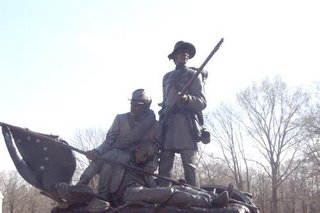
Yesterday F went to Shiloh with a friend who is still in high school. The friend had to visit a historic place during her spring break (the concept of which this high school does not seem to grasp.)
F is one of those people who like history and who like knowing interesting and useless things. We visited Shiloh when she was studying the Civil War during her high school U.S. History class and on the way there she told us all about what we would see, who fought there, what happened, the outcome and effect on the war, and so forth. So when the friend had to go, and her mom told her to try to find someone to go with them because of the long drive and so forth, F asked to be put on on the short list. Actually, she was the only taker.
Various states have put up elaborate monuments to their soldiers who died there. F says an equal number of soldiers from Tennessee fought on each side. Here is a picture she took of the Tennessee monument:
And here is a detail of the dying flag-carrying boy:
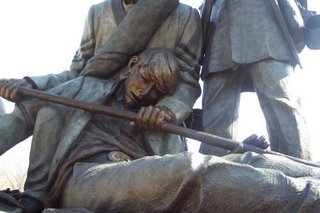
I am reminded of The Red Badge of Courage, that godawful thing they force helpless high schoolers to read (or did in my day), and of Ray Bradbury's short story "The Drummer Boy of Shiloh", and of Kipling's Drums of the Fore and Aft although that was a different war. This last story F and I read together last night. I miss sharing things like that with her when she's not here.
F is one of those people who like history and who like knowing interesting and useless things. We visited Shiloh when she was studying the Civil War during her high school U.S. History class and on the way there she told us all about what we would see, who fought there, what happened, the outcome and effect on the war, and so forth. So when the friend had to go, and her mom told her to try to find someone to go with them because of the long drive and so forth, F asked to be put on on the short list. Actually, she was the only taker.
Various states have put up elaborate monuments to their soldiers who died there. F says an equal number of soldiers from Tennessee fought on each side. Here is a picture she took of the Tennessee monument:
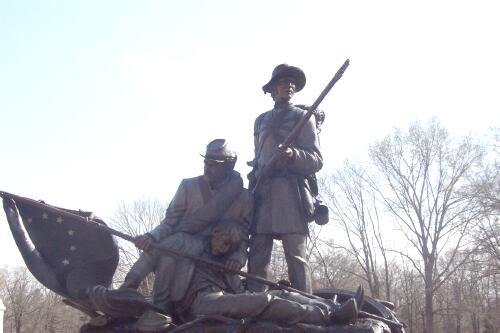
And here is a detail of the dying flag-carrying boy:

I am reminded of The Red Badge of Courage, that godawful thing they force helpless high schoolers to read (or did in my day), and of Ray Bradbury's short story "The Drummer Boy of Shiloh", and of Kipling's Drums of the Fore and Aft although that was a different war. This last story F and I read together last night. I miss sharing things like that with her when she's not here.
Friday, January 27, 2006
Some notes on Sally Brown, who knows her onions.
The actual origin of the phrase "she knows her onions" isn't known. You run across it now and then but it seems to have appeared in the 1920's along with some other whimsical phrases. It simply means that Sally has common sense and knows what she's about. Scroll down for more.
"She's in a Ziegfeld show".
"She don't get out and walk" - Sally has no need to economize by getting off the bus or out of the taxi before it takes her all the way to where she's going.
"All she gets is forty per" - Forty cents per hour? Forty dollars per week? Don't know.
"You ought to see her lavalier
(Lavalier: (Negligee Pendant): A necklace with two pendants of unequal length suspended from it.)
"She stays out after 'leven, right in the city's whirl,
'Cause she believes that heaven protects the working girl".
"She hates finale hoppers."
(Young man who arrives after all bills are paid.)
and finally,
"She hardly ever dances with a collegiate sheik.
She don’t take any chances – she likes ‘em old and weak.
Never goes on auto dates
Without taking roller skates.
She’s a girl who knows her onions."
I once read an autobiography of Louise Brooks. Sadly, it appears to be out of print. It was funny and readable and had a lot of interesting stuff in it. Apparently in the '20's it was the thing for wealthy older men to pick out a girl, an actress or a chorus girl, to spend lots of money on. It gave him status among his peers if she could show up at nightclubs wearing very expensive furs and jewelry, and being driven in showy cars and so forth. Brooks said that, believe it or not, most of the time those relationships did not involve sex. You can see why the girls would try to keep it on that level if they could. For one thing, reliable birth control was not readily available. If the girl got pregnant, she couldn't keep working and she couldn't count on continued support from her sugar daddy. The law was not on her side in those days, and public opinion certainly wouldn't have been; not like now, when I'm faintly surprised whenever a pregnant celebrity turns out to be married. For another, these girls had to really guard their reputations because they were on a slippery slope anyway. If they were thought to really be prostitutes, they were one step away from standing on a street corner. (Think of Gigi, and how carefully her grandmama and Aunt Alicia guarded her reputation until a contract could be signed with Gaston to provide for her future.) So Sally Brown's perspicacity was revealed in the fact that she was never in a position where a man could compromise her. Apparently that meant giving up good-looking boyfriends her age, but it was a price she was willing to pay.
So it's a cute little piece, and I hope I haven't analyzed it to death. Where did I run across it? Well, that's another story.
The actual origin of the phrase "she knows her onions" isn't known. You run across it now and then but it seems to have appeared in the 1920's along with some other whimsical phrases. It simply means that Sally has common sense and knows what she's about. Scroll down for more.
"She's in a Ziegfeld show".
"She don't get out and walk" - Sally has no need to economize by getting off the bus or out of the taxi before it takes her all the way to where she's going.
"All she gets is forty per" - Forty cents per hour? Forty dollars per week? Don't know.
"You ought to see her lavalier
(Lavalier: (Negligee Pendant): A necklace with two pendants of unequal length suspended from it.)
"She stays out after 'leven, right in the city's whirl,
'Cause she believes that heaven protects the working girl".
"She hates finale hoppers."
(Young man who arrives after all bills are paid.)
and finally,
"She hardly ever dances with a collegiate sheik.
She don’t take any chances – she likes ‘em old and weak.
Never goes on auto dates
Without taking roller skates.
She’s a girl who knows her onions."
I once read an autobiography of Louise Brooks. Sadly, it appears to be out of print. It was funny and readable and had a lot of interesting stuff in it. Apparently in the '20's it was the thing for wealthy older men to pick out a girl, an actress or a chorus girl, to spend lots of money on. It gave him status among his peers if she could show up at nightclubs wearing very expensive furs and jewelry, and being driven in showy cars and so forth. Brooks said that, believe it or not, most of the time those relationships did not involve sex. You can see why the girls would try to keep it on that level if they could. For one thing, reliable birth control was not readily available. If the girl got pregnant, she couldn't keep working and she couldn't count on continued support from her sugar daddy. The law was not on her side in those days, and public opinion certainly wouldn't have been; not like now, when I'm faintly surprised whenever a pregnant celebrity turns out to be married. For another, these girls had to really guard their reputations because they were on a slippery slope anyway. If they were thought to really be prostitutes, they were one step away from standing on a street corner. (Think of Gigi, and how carefully her grandmama and Aunt Alicia guarded her reputation until a contract could be signed with Gaston to provide for her future.) So Sally Brown's perspicacity was revealed in the fact that she was never in a position where a man could compromise her. Apparently that meant giving up good-looking boyfriends her age, but it was a price she was willing to pay.
So it's a cute little piece, and I hope I haven't analyzed it to death. Where did I run across it? Well, that's another story.
Friday, December 16, 2005
F and I are looking at pictures of Patagonia. ("We're nerds, you realize", she said.) We ran across this:

It's a cave painting where it looks like the inhabitants placed their hands on the cave wall and somehow sprayed paint to leave silhouettes. Look at their thumbs - they're not offset. What's up with that? Or is it our thumbs that are unusual? Are the hands of modern-day Argentinian and Chilean Indians like that? Any North American Indians? Polynesians? The internet answers many questions but it also raises others.
Here's the site.
I did get one fairly obscure question answered last year. When Molly came to us I wondered if the way her coloring is distributed on her body could be a map of her development as an embryo. Strangely enough, I found several websites related to cat embryology, and discovered that I was right. Here is an example.

It's a cave painting where it looks like the inhabitants placed their hands on the cave wall and somehow sprayed paint to leave silhouettes. Look at their thumbs - they're not offset. What's up with that? Or is it our thumbs that are unusual? Are the hands of modern-day Argentinian and Chilean Indians like that? Any North American Indians? Polynesians? The internet answers many questions but it also raises others.
Here's the site.
I did get one fairly obscure question answered last year. When Molly came to us I wondered if the way her coloring is distributed on her body could be a map of her development as an embryo. Strangely enough, I found several websites related to cat embryology, and discovered that I was right. Here is an example.
Sunday, December 04, 2005
You young folks, like change destiny, can't fully appreciate how technology has changed in the lifetimes of even us not-yet-old ones. F asked me once what computer games I liked when I was a little girl.
There were no computer games when I was a little girl.
Remember the scene in Apollo 13, where Tom Hanks waves his hand at a building and says it contains "the computer"? And the scene where people in the control room were doing calculations with slide rules? I was 9 years old then. When I started college, you could play Pac Man and Space Invaders in an arcade, and that was about it. Papers were typed on typewriters. Research was done in the library, with actual books. A notebook was a three-ring binder with paper in it. The Internet was a subject for science fiction.
So every now and then I hear a phrase, or run across one in my surfing, and it gives me a little jolt to think about what we would have made of it when I was a teenager.
- I went to Office Depot to buy a little wheel for my mouse.
- A worm shut down the Maryland Department of Motor Vehicles and the New York Times (this happened a few years ago, remember?)
- If you get email from the FBI, don't open it - it's a virus.
- The server has crashed. We might as well go home.
- I'm going to blog about this.
There were no computer games when I was a little girl.
Remember the scene in Apollo 13, where Tom Hanks waves his hand at a building and says it contains "the computer"? And the scene where people in the control room were doing calculations with slide rules? I was 9 years old then. When I started college, you could play Pac Man and Space Invaders in an arcade, and that was about it. Papers were typed on typewriters. Research was done in the library, with actual books. A notebook was a three-ring binder with paper in it. The Internet was a subject for science fiction.
So every now and then I hear a phrase, or run across one in my surfing, and it gives me a little jolt to think about what we would have made of it when I was a teenager.
- I went to Office Depot to buy a little wheel for my mouse.
- A worm shut down the Maryland Department of Motor Vehicles and the New York Times (this happened a few years ago, remember?)
- If you get email from the FBI, don't open it - it's a virus.
- The server has crashed. We might as well go home.
- I'm going to blog about this.
Thursday, October 27, 2005
Okay, time for more controversy. Went to lunch with some co-workers today, and we started talking about the Nathan Bedford Forrest statue, which is quite large and depicts him on a horse, and stands in the eponymous city park. Earlier this year there were some people trying to get that statue, and the bodies of him and his wife, moved back to historic Elmwood Cemetary where they originally were. There were demonstrations, and counter-demonstrations by the Sons of Confederate Veterans or some such, and in the end the park was unchanged.
We had quite a lively discussion about that statue. My contention is that it needs to be moved yesterday, and that park renamed. Why? Because Forrest was (a) an army general in a country (C.S.A.) that was at war with my country (U.S.A.) from its conception to its demise; (b) a founding member of the KKK; and (c) a slave trader. Not just owner, trader; he made his fortune from buying and selling black folks. And possibly (d) a war criminal too, depending on your take of the Fort Pillow massacre. One of my coworkers argued that slave trading wasn't different from slaveholding (I disagree) and that if we get rid of the Forrest statue we have to go after the Washington Monument next. My answer was, tell me something positive that Forrest contributed to the world, that means he needs to be honored by the City of Memphis. The statue's been there 100 years, isn't that enough? And further, white folks like to tell black folks to quit griping about the legacy of slavery, 400 years of oppression, Jim Crow, and so forth; let go of the past and get with the program. If I were black, all I would have to do in response is point to that statue and ask why black people have to let go of the bad old days when white people clearly refuse to.
I feel the same way about the Confederate flag. When Ole Miss banned the waving of that flag at football games many years ago, I thought that they were throwing away an old tradition. Turns out that flag only started being waved when Ole Miss was desegregated. That puts a totally different spin on the whole thing, and it's what started me down the path of disliking displays of those things.
If people want to have the Confederate flag displayed in their home or business, I wouldn't stop them. I think it has no place as part of a state flag, or flying on government property (except military parks like Shiloh).
And I consider myself a Southerner, yes, I do. Those years from 1861 to 1865 do not define the South. I've lived here all my life and I never want to live anywhere else. "American by birth, Southern by the Grace of God"; I feel that way, and I'd wear the shirt if I could get one without that cottonpickin' flag.
So why do so many white Southerners insist on holding on to that stuff? And why does racism persist so? C.S. Lewis wrote that people have trouble forgiving people they have wronged. If that sounds backwards, it's not. I think being a white person who is not a racist means not sharing the guilt of those who were responsible for slavery, Jim Crow, and so forth. That doesn't mean defensively saying "I didn't enslave anybody!" It means letting go of all that old crap and not identifying with it anymore. Slavery was and is an evil thing. Horrible and wretched. There's no excuse for it and there never has been. I refuse to defend it. I'd like to think that if I had lived in the antebellum South I would have had the moral clarity and the guts to be an abolitionist, like I am an abolitionist about abortion now. It would have taken a lot of courage, that's for sure.
We had quite a lively discussion about that statue. My contention is that it needs to be moved yesterday, and that park renamed. Why? Because Forrest was (a) an army general in a country (C.S.A.) that was at war with my country (U.S.A.) from its conception to its demise; (b) a founding member of the KKK; and (c) a slave trader. Not just owner, trader; he made his fortune from buying and selling black folks. And possibly (d) a war criminal too, depending on your take of the Fort Pillow massacre. One of my coworkers argued that slave trading wasn't different from slaveholding (I disagree) and that if we get rid of the Forrest statue we have to go after the Washington Monument next. My answer was, tell me something positive that Forrest contributed to the world, that means he needs to be honored by the City of Memphis. The statue's been there 100 years, isn't that enough? And further, white folks like to tell black folks to quit griping about the legacy of slavery, 400 years of oppression, Jim Crow, and so forth; let go of the past and get with the program. If I were black, all I would have to do in response is point to that statue and ask why black people have to let go of the bad old days when white people clearly refuse to.
I feel the same way about the Confederate flag. When Ole Miss banned the waving of that flag at football games many years ago, I thought that they were throwing away an old tradition. Turns out that flag only started being waved when Ole Miss was desegregated. That puts a totally different spin on the whole thing, and it's what started me down the path of disliking displays of those things.
If people want to have the Confederate flag displayed in their home or business, I wouldn't stop them. I think it has no place as part of a state flag, or flying on government property (except military parks like Shiloh).
And I consider myself a Southerner, yes, I do. Those years from 1861 to 1865 do not define the South. I've lived here all my life and I never want to live anywhere else. "American by birth, Southern by the Grace of God"; I feel that way, and I'd wear the shirt if I could get one without that cottonpickin' flag.
So why do so many white Southerners insist on holding on to that stuff? And why does racism persist so? C.S. Lewis wrote that people have trouble forgiving people they have wronged. If that sounds backwards, it's not. I think being a white person who is not a racist means not sharing the guilt of those who were responsible for slavery, Jim Crow, and so forth. That doesn't mean defensively saying "I didn't enslave anybody!" It means letting go of all that old crap and not identifying with it anymore. Slavery was and is an evil thing. Horrible and wretched. There's no excuse for it and there never has been. I refuse to defend it. I'd like to think that if I had lived in the antebellum South I would have had the moral clarity and the guts to be an abolitionist, like I am an abolitionist about abortion now. It would have taken a lot of courage, that's for sure.
Subscribe to:
Posts (Atom)